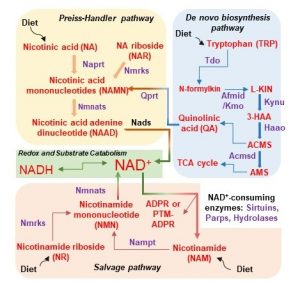
Our laboratory studies how metabolism affects pathogeneses of heart disease induced by different cardiac risk factors (diabetes, obesity, hypertension and aging). We are particularly interested in dissecting the relationships between mitochondrial and NAD+ metabolism with cardiac function. NAD+ regulates substrate catabolism as a redox cofactor by recycling of NAD+ and NADH. We showed that low NAD+/NADH ratio is induced by pressure overload or diabetes, and contributes to cardiac dysfunction (Lee et al., Circulation 2016, PMID: 27489254 and Chiao et al., Circulation: Heart Failure 2021, PMID: 34374300). Cellular NAD+ levels are also governed by the balance NAD+ consumption and the three synthesis pathways (Figure). Emerging data show that enzymes and metabolites in these pathways can regulate cell function and death. Our projects aim to explore how NAD+ metabolism affects nuclear, cellular, mitochondrial and cardiac functions. Currently we have three major directions:
- Interactions of NAD+redox state, consumption and synthesis in heart disease. We follow up our previous studies (PMIDs: 27489254, 34374300) and hypothesize that NAD+redox imbalance affects NAD+ metabolism via consumption and synthesis pathways, and thus promotes cardiac dysfunction. We use genetic models manipulating NAD+ redox state and synthesis, and targeted multi-omics analyses to test this hypothesis. We also studies SARM1, an intracellular NAD+ hydrolase that has been shown to play crucial role in axonal degeneration in neurons. We developed and use different genetic tools to determine how SARM1 regulates cellular, mitochondrial and NAD+ metabolism, in turn to contribute to cardiac dysfunction induced by different cardiac risk factors.
- Impacts of diet-induced obesity (DIO) and aging on NAD+metabolism and heart disease. We are dissecting the changes of cardiac NAD+metabolism induced in DIO mice or in old mice. We expect to identify unique and common changes and determine how DIO or aging, the two risk factors of diastolic heart failure, change NAD+ metabolism and cause diastolic dysfunction synergistically.
- Roles of mitochondrial function in arrhythmogenesis. This project investigates how mitochondrial function interacts with NAD+metabolism and CaMKII function in arrhythmogenesis.
Figure: